
Quick answer
Estonia has about 272 registered companies per 1,000 residents. Latvia has 120 and Lithuania 81. Estonia also has the most companies in absolute terms, 369,958, although its population is the smallest of the three. Business is concentrated around the capitals everywhere: the Riga region holds 62% of Latvian companies, Harju County 55% of Estonian ones and Vilnius County 44% of Lithuanian ones.
Estonia, Latvia and Lithuania are often treated as one region, yet their business registers tell three very different stories. We took the official open-data extracts of all three national registers as of 8 October 2026 and kept only the entities that are registered and not being wound up. Then we compared the number of companies in each country, their business density per resident, and where in each country they are registered.
The result is a picture of three neighbours with very different corporate geographies. One of them has a company for roughly every four residents, another for every twelve.
How Many Companies Are in the Baltic States?
| Country | Registered legal entities | Population (1 Jan 2026) | Per 1,000 residents | Residents per entity |
|---|---|---|---|---|
| Estonia | 369,958 | 1,360,745 | 271.9 | 3.7 |
| Latvia | 221,388 | 1,845,096 | 120.0 | 8.3 |
| Lithuania | 235,175 | 2,887,592 | 81.4 | 12.3 |
| Baltic states total | 826,521 | 6,093,433 | 135.6 | 7.4 |
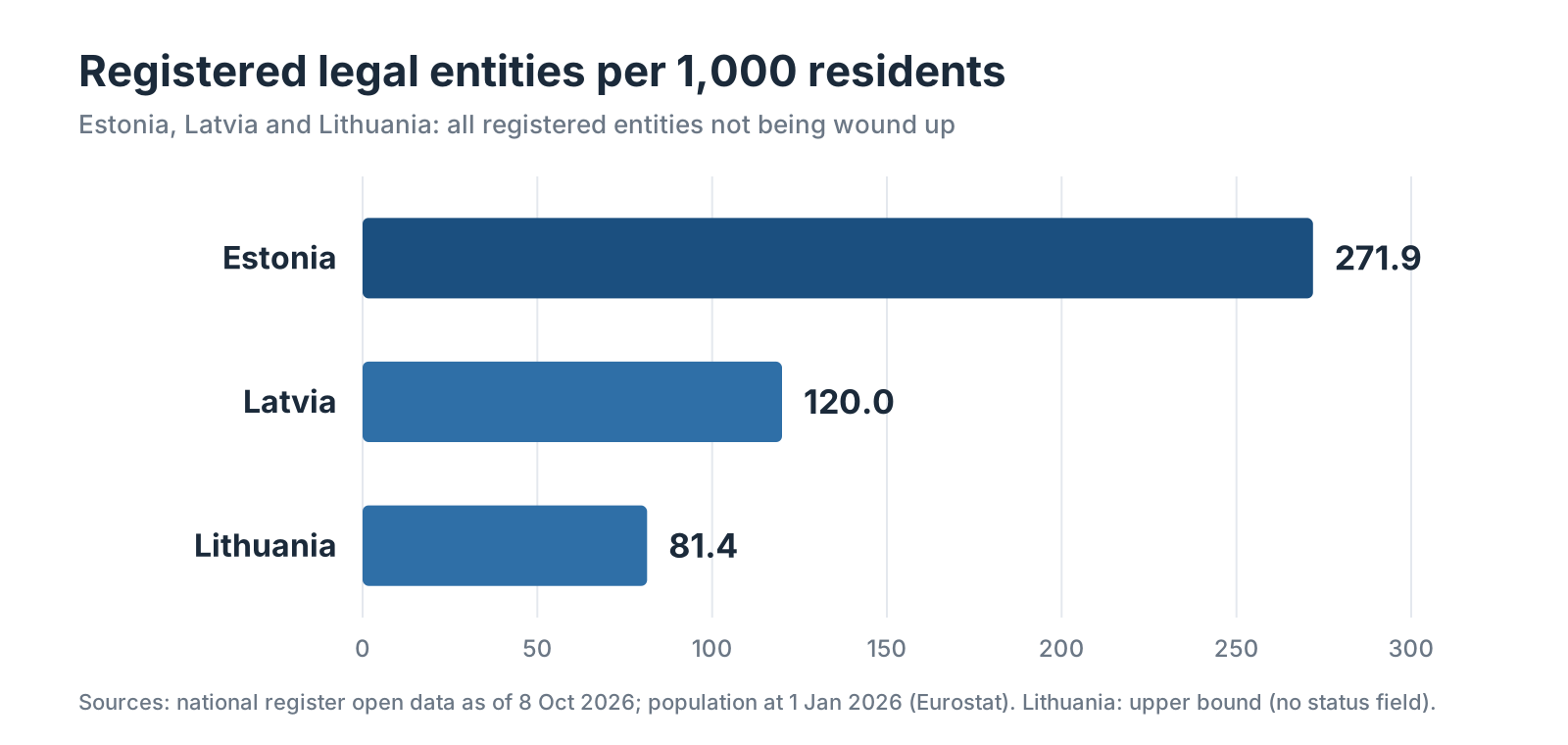
Measured against population, the three Baltic economies could hardly be more different. Estonia has 22% of the Baltic population but 45% of all registered entities, which works out at roughly one company for every four residents. Lithuania is the reverse: it is home to almost half of the Baltic population (47%) but only 28% of the registered businesses. Latvia sits close to proportional, with 30% of the population and 27% of the entities.
The figures cover all registered legal entities, not only commercial companies. Estonia’s total includes 25,625 apartment associations, 22,685 non-profit associations and 24,600 sole proprietors, while Latvia’s includes farms, associations and other forms. Even without those three Estonian groups, Estonia would still have about 218 companies per 1,000 residents, far ahead of its neighbours. The selection rules are set out in the methodology section below.
Why Estonia Has So Many Companies
The registers show the gap but not its cause. The likeliest explanation is how easy Estonia makes it to start and keep a business. Company formation is fully online, non-residents can set up a company remotely through e-Residency, and profit left in the company is not taxed until it is paid out. Part of the Estonian register therefore belongs to founders living abroad, and part, in all likelihood, to small companies that mainly hold or reinvest money.
Tax alone does not explain the difference, though. Latvia also taxes only distributed profit, yet its business density is less than half of Estonia’s. That points to the digital, remote-friendly formation process as the factor that matters most.
Where Companies Are Registered: Capitals and Regions
In every Baltic country the capital attracts the largest share of company registrations, but the degree of concentration varies. To compare like with like, we counted each capital at two levels: the city itself and the wider capital region. For Estonia that region is Harju County, for Latvia it is Riga together with the surrounding Pierīga municipalities, and for Lithuania it is Vilnius County.
| Country | Capital city | Share of national total | Capital region | Share of national total |
|---|---|---|---|---|
| Estonia | Tallinn: 158,868 | 42.9% | Harju County: 204,462 | 55.3% |
| Latvia | Riga: 91,991 | 41.6% | Riga and Pierīga: 136,840 | 61.8% |
| Lithuania | Vilnius: 85,381 | 36.3% | Vilnius County: 102,650 | 43.6% |
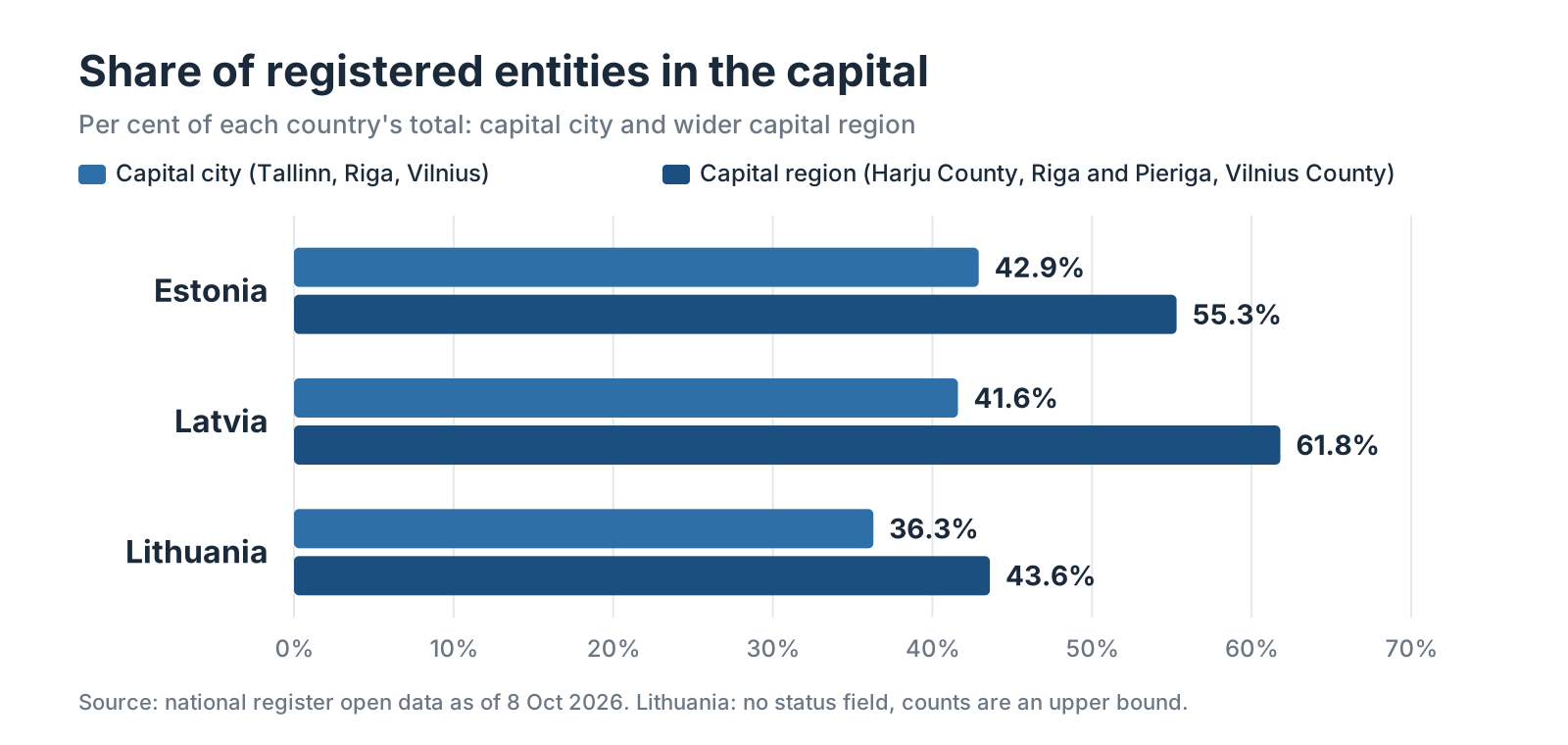
The two levels tell slightly different stories. Looking at the cities alone, Tallinn leads with 42.9%, just ahead of Riga at 41.6%, while Vilnius trails at 36.3%. Once the surrounding municipalities are added, Latvia becomes the most capital-centred country in the Baltics: the Riga region holds 61.8% of all Latvian companies, against 55.3% for Harju County and 43.6% for Vilnius County. Lithuania, with Kaunas as a genuine second centre, is the least centralised at both levels. In absolute numbers Tallinn remains the largest business centre in the region, with 158,868 registered entities against 91,991 in Riga and 85,381 in Vilnius. Harju County alone holds more companies than the Riga region or Vilnius County.
Estonia: Harju County Holds More Than Half
| County | Entities | Share of national total |
|---|---|---|
| Harju County (incl. Tallinn) | 204,462 | 55.3% |
| Tartu County | 36,753 | 9.9% |
| Pärnu County | 18,385 | 5.0% |
| Ida-Viru County | 15,342 | 4.1% |
| Lääne-Viru County | 10,443 | 2.8% |
Harju County accounts for 55.3% of Estonian companies and has more than five times as many as second-placed Tartu County. Tallinn itself holds 158,868 of them, or 42.9% of the national total, and the top five counties together hold 77.1%. One reason is that many businesses, especially those with owners abroad, are registered at a legal address in Tallinn or use a virtual office there, wherever the owners themselves live. For a breakdown of Estonian company statistics by city and Tallinn district, see our study of where Estonian companies are registered.
Latvia: Riga Holds Two in Five
| Territory | Entities | Share of national total |
|---|---|---|
| Riga (city) | 91,991 | 41.6% |
| Liepāja (city) | 6,305 | 2.8% |
| Ogre Municipality | 6,206 | 2.8% |
| Mārupe Municipality | 5,883 | 2.7% |
| Jūrmala (city) | 5,706 | 2.6% |
Riga is home to 41.6% of Latvian companies, more than 14 times as many as Liepāja, the runner-up. The city’s pull extends well beyond its boundaries: Jūrmala, Mārupe, Ogre and the other Pierīga municipalities around the capital add another 20 percentage points, which is why the Riga region as a whole reaches 61.8%.
Lithuania: Two Strong Business Centres
| Territory | Entities | Share of national total |
|---|---|---|
| Vilnius (city) | 85,381 | 36.3% |
| Kaunas (city) | 31,068 | 13.2% |
| Klaipėda (city) | 12,710 | 5.4% |
| Kaunas District | 8,301 | 3.5% |
| Vilnius District | 7,872 | 3.3% |
Vilnius accounts for 36.3% of Lithuanian companies, and the whole of Vilnius County for 43.6%. Lithuania is the only Baltic country with a strong second business hub: Kaunas holds 13.2%, and the two cities together almost half (49.5%). For founders considering company registration in Lithuania, that means a genuine choice of base rather than a single default.
Methodology: How We Defined an Active Company
All figures come from the official open-data extracts published by the three national registers (links in the table), as of 8 October 2026, and are counted by unique registration code. Each register records an entity’s status differently, so each country needed its own rule for what counts as an active company.
| Country | Register and file | Counted as active | Left out |
|---|---|---|---|
| Estonia | e-Business Register (RIK) open data, ettevotja_rekvisiidid__lihtandmed.csv |
Status R (entered in the register) | 8,744 in liquidation (status L) and 675 in bankruptcy (status N); deleted entities are not in the file |
| Latvia | Register of Enterprises open data, register.csv |
No termination date (empty terminated field) |
All entities with a termination date |
| Lithuania | Register of Legal Entities (Registrų centras) open data, JAR_ADRESAI.csv |
Every unique code in the address file | Nothing could be filtered, as the file has no legal-status field |
What “active” means here. An entity counts as active if the register shows it as existing and not being wound up. This is a legal status, not a measure of business activity, and a registered company may have no turnover or staff at all. Statistics offices and Eurostat publish separate, usually lower figures for “active enterprises”, meaning businesses with turnover, staff or investment during the year.
Limitations:
- Lithuania. Without a status field, liquidated or deregistered entities could not be removed, so Lithuania’s figure is an upper bound: its true density is 81 per 1,000 residents or lower.
- Latvia. An empty termination date does not by itself prove that no liquidation is under way.
- Legal forms. The registers cover different sets of legal forms. A strictly comparable “commercial companies per 1,000 residents” figure would need one common classification across all three countries.
- Addresses and regions. Regions follow the registered address, which is not necessarily where the business operates. Harju County and Vilnius County are official administrative units; the Riga region is a working grouping of Riga city, Jūrmala and the surrounding Pierīga municipalities, and in Latvia address prefixes do not fully reflect past changes to municipal boundaries.
Calculations. Regional share = entities in the region ÷ entities in the country × 100. Density = entities ÷ population × 1,000. Results are rounded to one decimal place. Population figures as at 1 January 2026 are from Eurostat (table tps00001); the Estonian figure matches Statistics Estonia.
Choosing Your Base in the Baltics
The numbers describe two different business landscapes. Estonia is dense, digital and centred on Tallinn, and a company there can be set up and run from abroad. Lithuania is larger, with business spread across two strong cities. Eesti Firma works in both countries. We help with registering a company in Estonia or in Lithuania, and Estonian companies can use our registered address and virtual office in Tallinn. Tell us what you are planning, and we will suggest a set-up that fits.
FAQ
Estonia, with 369,958 registered legal entities, ahead of Lithuania (235,175) and Latvia (221,388). It also has the smallest population of the three Baltic states.
Latvia’s Register of Enterprises lists 221,388 legal entities without a termination date, or 120 per 1,000 residents. Riga city alone accounts for 91,991 of them (41.6%), and the wider Riga region for 136,840 (61.8%).
Lithuania’s Register of Legal Entities lists 235,175 legal entities, or 81 per 1,000 residents. Because the open-data file has no status field, this number may include companies that are already being wound up. Vilnius city accounts for 85,381 (36.3%), Vilnius County for 102,650 (43.6%) and Kaunas city for 31,068 (13.2%).
In absolute numbers, in Harju County, the Estonian county that includes Tallinn: 204,462 registered entities, against 136,840 in the Riga region and 102,650 in Vilnius County. As a share of the national total, the Riga region leads with 61.8%.
Not necessarily. The figures count entities that are legally registered and not being wound up, and many of them may have no turnover or staff. Statistics offices count “active enterprises”, meaning businesses with turnover, staff or investment during the year, so their totals are usually lower.
Our county and city study counts only commercial companies (OÜ, AS and other business forms). This Baltic comparison includes every registered entity, including apartment associations, non-profit associations and sole proprietors, so the total is higher.