Quick answer
New LEI registrations reached 354,975 worldwide in 2025, more than a quarter up on 2024, and kept growing in 2026. India issues the most new codes, while in Europe Estonia grew fastest, with 43% more new LEIs in the first ten months of 2026 than a year earlier.
More companies need an LEI, a Legal Entity Identifier, every year, because banks, brokers and regulators ask for it in more situations. The number of new LEI registrations shows where that demand is growing, and it varies a great deal from country to country. Companies that need a code for a bank or broker can apply for an LEI through us.
We counted new LEIs in the database of the Global Legal Entity Identifier Foundation (GLEIF) on 6 November 2026, by the date each code was first issued. Renewals and transfers between issuers are not new registrations, so they are not included. We cover renewals separately in our article on LEI renewal rates by country.
How Many New LEIs Are Issued Each Year
Issuance rose by about 28% in 2025 and kept growing in 2026, though more slowly. The figure for 2024 comes from GLEIF’s annual review, the others from our own count.
| Period | New LEIs worldwide | Change |
|---|---|---|
| 2024 | just over 278,000 | – |
| 2025 | 354,975 | about +28% on 2024 |
| January to October 2025 | 295,665 | – |
| January to October 2026 | 314,876 | +6.5% on the same months of 2025 |
GLEIF’s review of 2025 gives a growth rate of 13.5% for that year. It measures new LEIs against the number of active codes at the start of the year, so it shows how fast the LEI population grows rather than how much issuance changed.
In the third quarter of 2026, GLEIF reported about 90,000 new LEIs, or roughly 1,400 per working day.
Countries Issuing the Most New LEIs
India issued 105,446 new LEIs in 2025, about 30% of the world total and more than the next four countries together.
| Country | New LEIs in 2025 |
|---|---|
| India | 105,446 |
| United States | 26,404 |
| Italy | 24,672 |
| France | 22,828 |
| Germany | 21,560 |
| Netherlands | 18,288 |
| United Kingdom | 16,472 |
| Spain | 13,354 |
| Sweden | 8,804 |
| Belgium | 8,537 |
Europe as a whole still issues more new LEIs than any other region. The EU, the four EFTA countries (Iceland, Liechtenstein, Norway and Switzerland) and the United Kingdom together accounted for 190,291 new codes in 2025, or 54% of the world total. Their share of all LEIs ever issued is even higher, at 63%, as our LEI statistics show.
New LEI Registrations in Europe by Country
From January to October 2026, Europe issued 11% more new LEIs than in the same months of 2025, faster than the 6.5% growth worldwide. The table shows every country of the EU, EFTA and the United Kingdom, ordered by new LEIs in 2025.
| Country | 2025 | Jan–Oct 2025 | Jan–Oct 2026 | Change (Jan–Oct) |
|---|---|---|---|---|
| Italy | 24,672 | 21,256 | 22,286 | +4.8% |
| France | 22,828 | 18,719 | 21,312 | +13.9% |
| Germany | 21,560 | 18,192 | 19,546 | +7.4% |
| Netherlands | 18,288 | 14,757 | 20,558 | +39.3% |
| United Kingdom | 16,472 | 13,561 | 14,227 | +4.9% |
| Spain | 13,354 | 10,827 | 12,344 | +14.0% |
| Sweden | 8,804 | 7,411 | 7,460 | +0.7% |
| Belgium | 8,537 | 7,051 | 7,514 | +6.6% |
| Denmark | 8,152 | 6,984 | 6,630 | −5.1% |
| Luxembourg | 5,188 | 4,278 | 4,437 | +3.7% |
| Norway | 4,736 | 3,963 | 4,735 | +19.5% |
| Finland | 4,298 | 3,475 | 4,300 | +23.7% |
| Poland | 4,146 | 3,580 | 3,308 | −7.6% |
| Ireland | 3,700 | 3,148 | 3,085 | −2.0% |
| Austria | 3,636 | 2,777 | 3,015 | +8.6% |
| Estonia | 3,055 | 2,507 | 3,580 | +42.8% |
| Czechia | 2,887 | 2,425 | 2,325 | −4.1% |
| Hungary | 2,420 | 1,888 | 2,003 | +6.1% |
| Switzerland | 2,329 | 1,986 | 1,803 | −9.2% |
| Portugal | 2,205 | 1,850 | 2,142 | +15.8% |
| Cyprus | 1,321 | 1,048 | 1,444 | +37.8% |
| Romania | 1,118 | 935 | 1,143 | +22.2% |
| Lithuania | 925 | 780 | 779 | −0.1% |
| Latvia | 887 | 786 | 894 | +13.7% |
| Greece | 830 | 695 | 770 | +10.8% |
| Slovakia | 763 | 640 | 724 | +13.1% |
| Bulgaria | 666 | 530 | 671 | +26.6% |
| Liechtenstein | 612 | 475 | 588 | +23.8% |
| Iceland | 611 | 505 | 312 | −38.2% |
| Malta | 530 | 417 | 589 | +41.2% |
| Slovenia | 426 | 363 | 470 | +29.5% |
| Croatia | 335 | 278 | 319 | +14.7% |
The Fastest-Growing LEI Markets
Estonia, which already has the third-highest number of LEIs per capita in Europe, grew fastest: its companies obtained 3,580 new LEIs from January to October 2026, against 2,507 a year earlier, an increase of 43%. Malta (+41%), the Netherlands (+39%) and Cyprus (+38%) followed closely. The Netherlands added the most codes in absolute terms, about 5,800 more than a year before. New registrations fell most in Iceland, Switzerland and Poland.
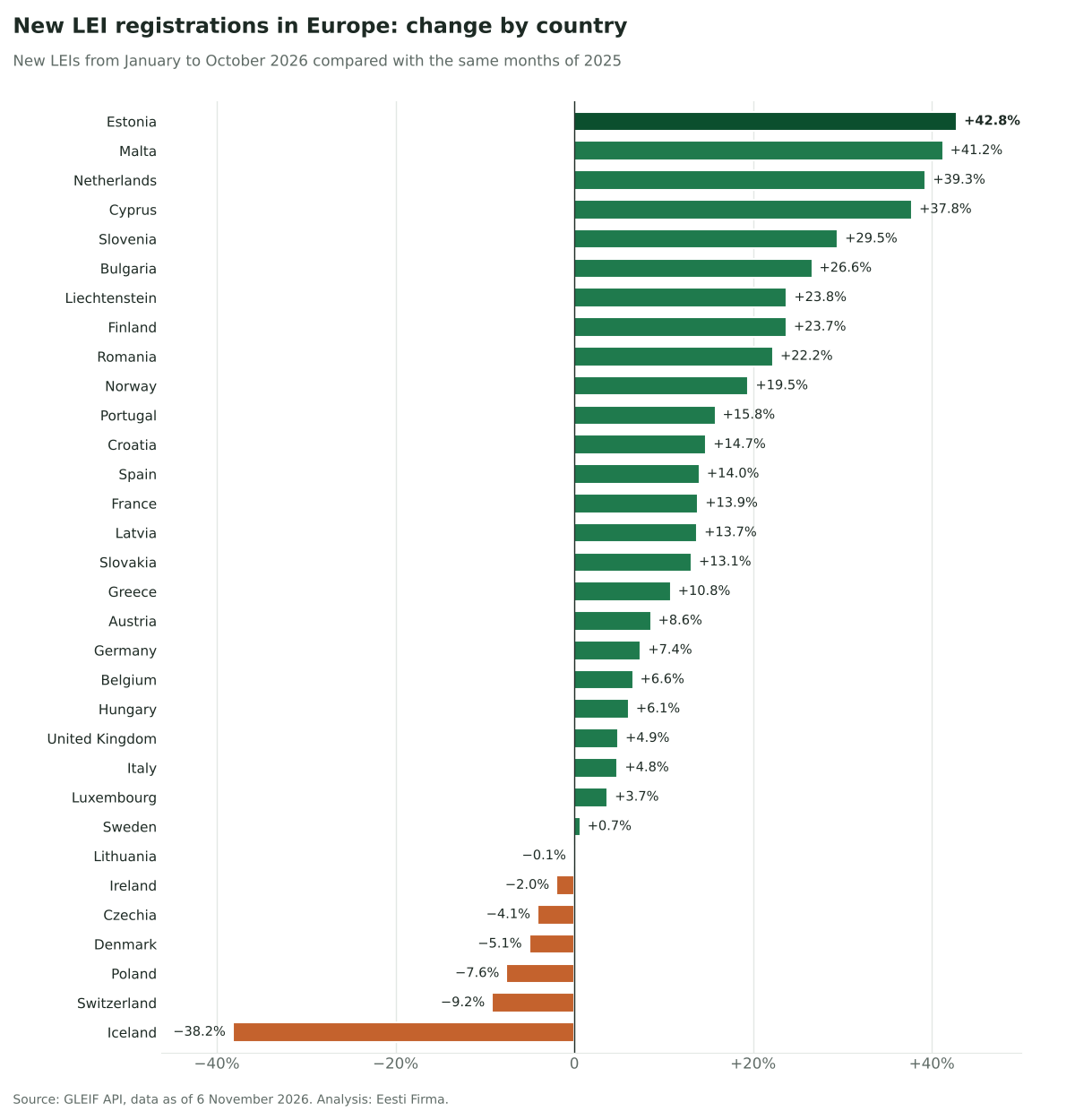
The GLEIF data does not show why Estonia grows so fast, but our own clients point to two reasons. Revolut Business, Interactive Brokers and banks such as LHV and SEB ask a company for an LEI before it can invest. At the same time, more owners choose to invest through an Estonian holding company rather than in their own name.
Outside Europe, Brazil nearly doubled its new registrations, from 388 in the first ten months of 2025 to 767 in the same months of 2026. GLEIF attributes Brazil’s growth mainly to the activity of local LEI issuers, supported by the central bank’s work on using the LEI in cross-border payments. The United Arab Emirates grew by 24% over the same period, while India, despite issuing the most codes, registered 3% fewer.
These results differ from GLEIF’s own LEI growth ranking. For the third quarter of 2026, it put India, Latvia, the United Arab Emirates, Indonesia and Lithuania on top, and for the whole of 2025 India (49.2%), Latvia (35.1%), Lithuania (26.1%), the United Arab Emirates (22.3%) and Saudi Arabia (18.7%). GLEIF measures new LEIs against the active LEIs a country already had, so a market ranks high by issuing many codes or by starting from a small base. India gets there through the sheer volume of its issuance, Latvia and Lithuania because their existing stock is small. Our table instead compares new registrations with the same months a year earlier, which shows whether demand is speeding up or slowing down.
What Drives Demand for New LEIs
Most new LEIs are needed because a bank, broker or regulator requires one for a specific transaction. Under MiFIR, the EU regulation on trading in financial instruments, investment firms must report each trade a company client makes in listed shares, bonds or ETFs with that client’s LEI. A company that wants to invest through a broker therefore needs a code first. Under EMIR, derivatives are reported with each party’s LEI too.
Newer rules add to the demand. Under DORA, the EU’s Digital Operational Resilience Act, banks and other financial firms must keep a register of information on their IT service providers. Under the implementing rules, providers based outside the EU are identified there by their LEI. Those in the EU can be identified by an LEI or by the European Unique Identifier (EUID), a free number from their business register. GLEIF links much of the recent growth in Latvia and Lithuania to these rules.
Outside Europe, national rules play a similar role. India requires LEIs from large bank borrowers and for large payments, which helps explain its lead.
Getting a New LEI for Your Company
We work with WM Datenservice, a GLEIF-accredited issuer, and you can apply for a new LEI on our LEI order page for companies from most countries. Enter the company’s registration number, and its details load from the business register. The code is usually issued within one or two working days.
Frequently Asked Questions
In 2025, 354,975 new LEIs were issued worldwide, about 28% more than in 2024, when GLEIF counted just over 278,000. From January to October 2026, issuance was 6.5% higher than in the same months of 2025.
About 1,400 per working day on average in the third quarter of 2026, according to GLEIF, which reported about 90,000 new LEIs for the quarter.
India, with 105,446 new LEIs in 2025, about 30% of the world total. The United States and Italy followed, with about 26,000 and 25,000.
Estonia. From January to October 2026, Estonian companies obtained 43% more new LEIs than in the same months of 2025, the highest growth among the 32 European countries we analysed, just ahead of Malta.