


Quick answer
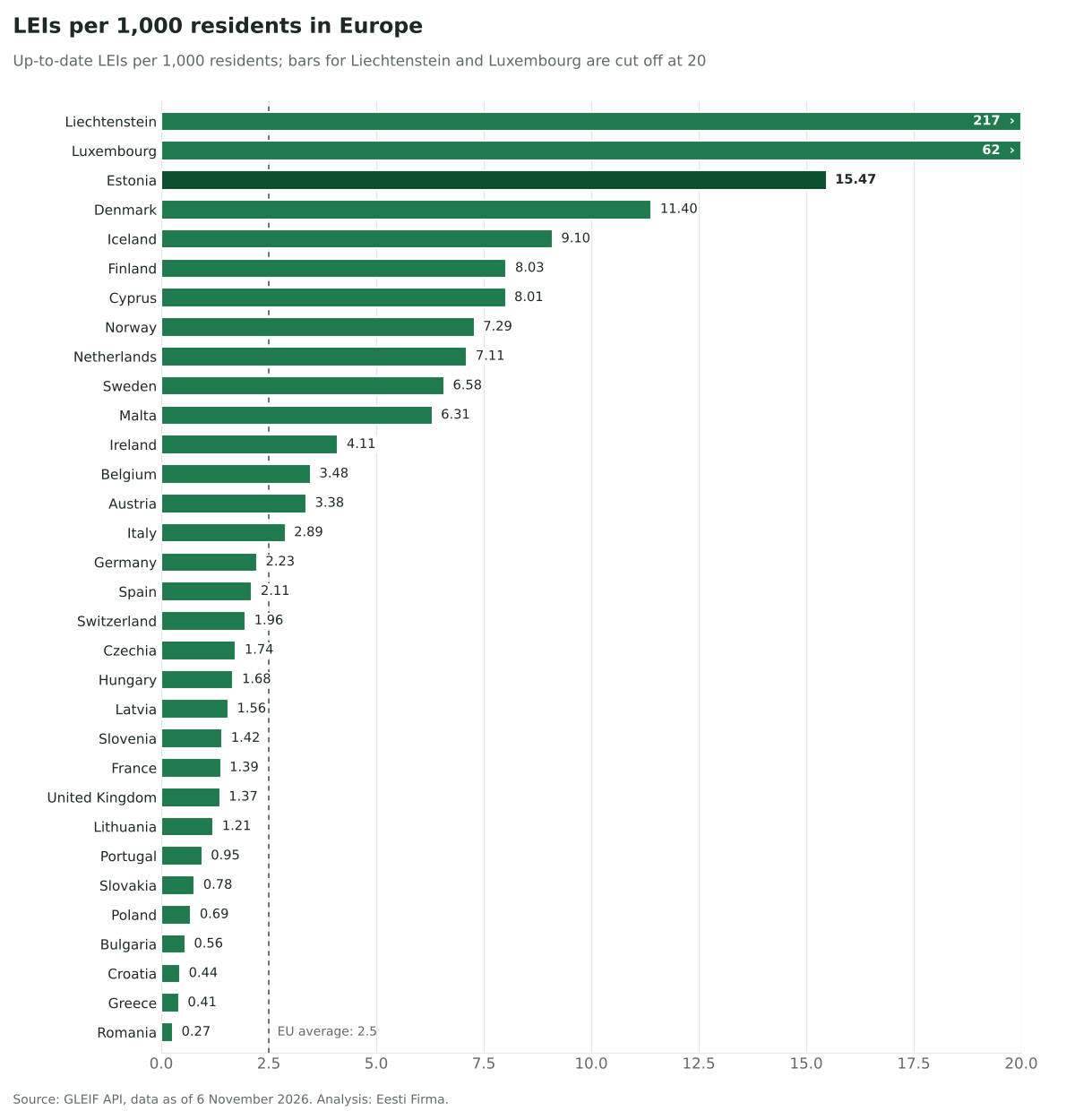
Liechtenstein has by far the most LEIs per capita in Europe, with 217 up-to-date codes per 1,000 residents, followed by Luxembourg. Estonia comes third with 15.5, about six times the EU average, while Romania, Greece and Croatia have the fewest.
Large economies such as Italy and Germany have the most LEIs, or Legal Entity Identifiers, in absolute numbers. Measured against population, the picture looks very different. The figure reflects both how many companies and other legal entities a country has and how widely they use financial services that require an LEI. If your company needs one, we can arrange an LEI for it.
LEIs per 1,000 People in Europe
The Global Legal Entity Identifier Foundation (GLEIF) publishes the number of LEIs by country but not in relation to population. We therefore counted the up-to-date LEIs, those with the status ISSUED, in each country of the EU, the four EFTA countries (Iceland, Liechtenstein, Norway and Switzerland) and the United Kingdom on 6 November 2026. We then divided them by the country’s population.
| Rank | Country | Up-to-date LEIs | Population | Per 1,000 residents |
|---|---|---|---|---|
| 1 | Liechtenstein | 8,957 | 41,227 | 217.26 |
| 2 | Luxembourg | 42,544 | 690,959 | 61.57 |
| 3 | Estonia | 21,050 | 1,360,745 | 15.47 |
| 4 | Denmark | 68,706 | 6,025,603 | 11.40 |
| 5 | Iceland | 3,589 | 394,324 | 9.10 |
| 6 | Finland | 45,389 | 5,652,881 | 8.03 |
| 7 | Cyprus | 7,983 | 996,571 | 8.01 |
| 8 | Norway | 40,996 | 5,627,400 | 7.29 |
| 9 | Netherlands | 128,935 | 18,130,208 | 7.11 |
| 10 | Sweden | 69,802 | 10,605,529 | 6.58 |
| 11 | Malta | 3,709 | 588,254 | 6.31 |
| 12 | Ireland | 22,658 | 5,510,565 | 4.11 |
| 13 | Belgium | 41,593 | 11,955,308 | 3.48 |
| 14 | Austria | 31,107 | 9,215,956 | 3.38 |
| 15 | Italy | 170,196 | 58,942,828 | 2.89 |
| 16 | Germany | 185,996 | 83,467,117 | 2.23 |
| 17 | Spain | 104,770 | 49,590,099 | 2.11 |
| 18 | Switzerland | 17,905 | 9,124,288 | 1.96 |
| 19 | Czechia | 18,957 | 10,915,839 | 1.74 |
| 20 | Hungary | 15,910 | 9,488,428 | 1.68 |
| 21 | Latvia | 2,883 | 1,845,096 | 1.56 |
| 22 | Slovenia | 3,036 | 2,135,107 | 1.42 |
| 23 | France | 95,966 | 69,112,309 | 1.39 |
| 24 | United Kingdom | 95,099 | 69,483,900 | 1.37 |
| 25 | Lithuania | 3,503 | 2,887,592 | 1.21 |
| 26 | Portugal | 10,876 | 11,424,031 | 0.95 |
| 27 | Slovakia | 4,200 | 5,409,407 | 0.78 |
| 28 | Poland | 25,219 | 36,332,765 | 0.69 |
| 29 | Bulgaria | 3,597 | 6,423,207 | 0.56 |
| 30 | Croatia | 1,701 | 3,876,002 | 0.44 |
| 31 | Greece | 4,291 | 10,366,586 | 0.41 |
| 32 | Romania | 5,168 | 19,041,322 | 0.27 |
Across the 27 EU countries, there are 2.5 up-to-date LEIs per 1,000 residents, and 15 of the 32 countries in the table are above that level.
Why Liechtenstein and Luxembourg Lead
Luxembourg is one of the world’s largest centres for investment funds, and funds need LEIs to trade and to report to regulators. Of its 42,544 up-to-date LEIs, 23,851, or 56%, belong to funds.
Liechtenstein’s lead has a different source. Funds hold only about 14% of its up-to-date LEIs, and most of the rest belong to companies, foundations and other legal entities registered there. The country has just over 41,000 residents, so a few thousand such entities are enough to put it far ahead.
Estonia in Third Place
Estonia has more up-to-date LEIs per person than any other country in Europe apart from the two financial centres: 15.5 per 1,000 residents, ahead of Denmark, Iceland and Finland. It is also far ahead of its Baltic neighbours, with about ten times as many codes per person as Latvia and 13 times as many as Lithuania.
Unlike Luxembourg, Estonia owes almost none of this to funds, which hold only 54 of its 21,050 up-to-date LEIs. Most codes belong to ordinary companies, and Estonia has plenty of those. Our study of companies per capita in the Baltic states counted about 272 registered legal entities per 1,000 residents, most of them companies. Foreign entrepreneurs add to this, because they can found and run an Estonian company remotely through e-Residency.
Estonia is also gaining ground. In the first ten months of 2026, new LEI registrations in Estonia rose by 43% on a year earlier, faster than in any other country we analysed, as our country-by-country overview shows. In our experience, this demand is driven by investing. More owners hold their investments through an Estonian company, and brokers and Revolut Business require such a company to have an LEI before it starts trading. We explain the rules in our guide to why brokers ask for an LEI.
Where LEIs Are Least Common
Romania, Greece, Croatia, Bulgaria and Poland have the fewest LEIs per person, all below 0.7 per 1,000 residents. Estonia’s figure is 57 times higher than Romania’s 0.27.
Some large economies also have a low LEI density. France and the United Kingdom have nearly 100,000 up-to-date LEIs each but only 1.4 per 1,000 residents, and Germany, with the most up-to-date codes in Europe, has 2.2. A low figure does not mean a weak economy. It usually means fewer legal entities per resident, or a smaller share of them investing, trading derivatives or using other financial services that require an LEI.
How We Calculated LEIs per Capita
We took the LEI counts from the GLEIF API on 6 November 2026 and placed each code in the country of its registered legal address. Only codes with the status ISSUED were counted, because lapsed codes and those of closed companies say little about current use.
Population figures are from Eurostat for 1 January 2026 and, for the United Kingdom, from the Office for National Statistics for mid-2025. Monaco, Andorra, San Marino, Gibraltar and the Crown Dependencies of Jersey, Guernsey and the Isle of Man are not included, because they are outside the EU, EFTA and the United Kingdom. If they were included, the financial centres of Jersey, Guernsey and Gibraltar would rank above Estonia. Offshore centres such as the Cayman Islands are not covered either.
How to Get an LEI for Your Company
We work with WM Datenservice, a GLEIF-accredited issuer, and companies registered in Estonia or most other countries can order their LEI through us. The form loads the company’s details from its business register, and most codes are issued within one or two working days.
Frequently Asked Questions
Liechtenstein, with 217 up-to-date LEIs per 1,000 residents on 6 November 2026. Luxembourg is second with 62 and Estonia third with 15.5, among the 32 countries of the EU, EFTA and the United Kingdom.
Estonia has 21,050 up-to-date LEIs, or 15.5 per 1,000 residents. That is about six times the EU average and the third-highest figure in Europe.
Luxembourg is a major centre for investment funds, and 56% of its up-to-date LEIs belong to funds. Funds need an LEI to trade securities and to report to regulators.
Across the EU, there are about 2.5 up-to-date LEIs per 1,000 residents. Fifteen of the 32 European countries we analysed are above this level.
