Quick answer
Estonia has about 144,000 e-residents and 1.36 million residents. e-Residency adds roughly 13,000 people a year, a pace unchanged for eight years, while the population is shrinking by several thousand a year. Count everyone ever granted e-Residency and the lines cross around the turn of the next century. Count living e-residents and they never cross: the total stalls at roughly half a million. Count valid e-Residency cards and e-residents are 4.6% of Estonians, and not gaining.
When e-Residency launched, its architect Taavi Kotka set a target that is still quoted: 10 million e-residents within a decade. Estonia has 1.36 million actual residents, so the promise amounted to seven e-residents of Estonia for every resident of Estonia. A decade on, the programme’s dashboard shows a little over 142,000 e-residents, and the population has started to shrink.
That raised a question at our office that has nothing to do with company law: how many e-residents will Estonia have, and when does that number overtake the number of Estonians? We run a company formation service built around e-Residency, so we usually deal with the practical side of the programme. This article is the opposite: a back-of-the-envelope projection, careful enough to be interesting and loose enough to be fun.
How Many e-Residents Does Estonia Have, and How Fast Is the Number Growing?
The programme reports its e-Residency numbers in percentages, so the first thing to check is whether the number of e-residents is accelerating. It is not. After a launch spike, new e-residents per year peaked at 20,520 in the programme’s fourth year, then settled into a band of 11,000–14,000. Last year’s 13,828 was the best result in six years, but it is the same level the programme reached before the pandemic.
| Year | Total e-residents | New that year | Growth of the total |
|---|---|---|---|
| 2017 | ~27,000 | ~12,000 | — |
| 2018 | ~48,000 | 20,520 | +75% |
| 2019 | ~64,000 | ~16,000 | +33% |
| 2020 | 76,070 | ~12,000 | +19% |
| 2021 | ~88,000 | ~12,000 | +16% |
| 2022 | ~99,000 | ~11,000 | +12% |
| 2023 | ~110,000 | ~11,000 | +11% |
| 2024 | ~121,000 | ~11,500 | +10% |
| 2025 | ~135,000 | 13,828 | +11% |
| 2026 (Sept) | ~144,000 | ~9,000 so far | ≈ +9–10% annualised |
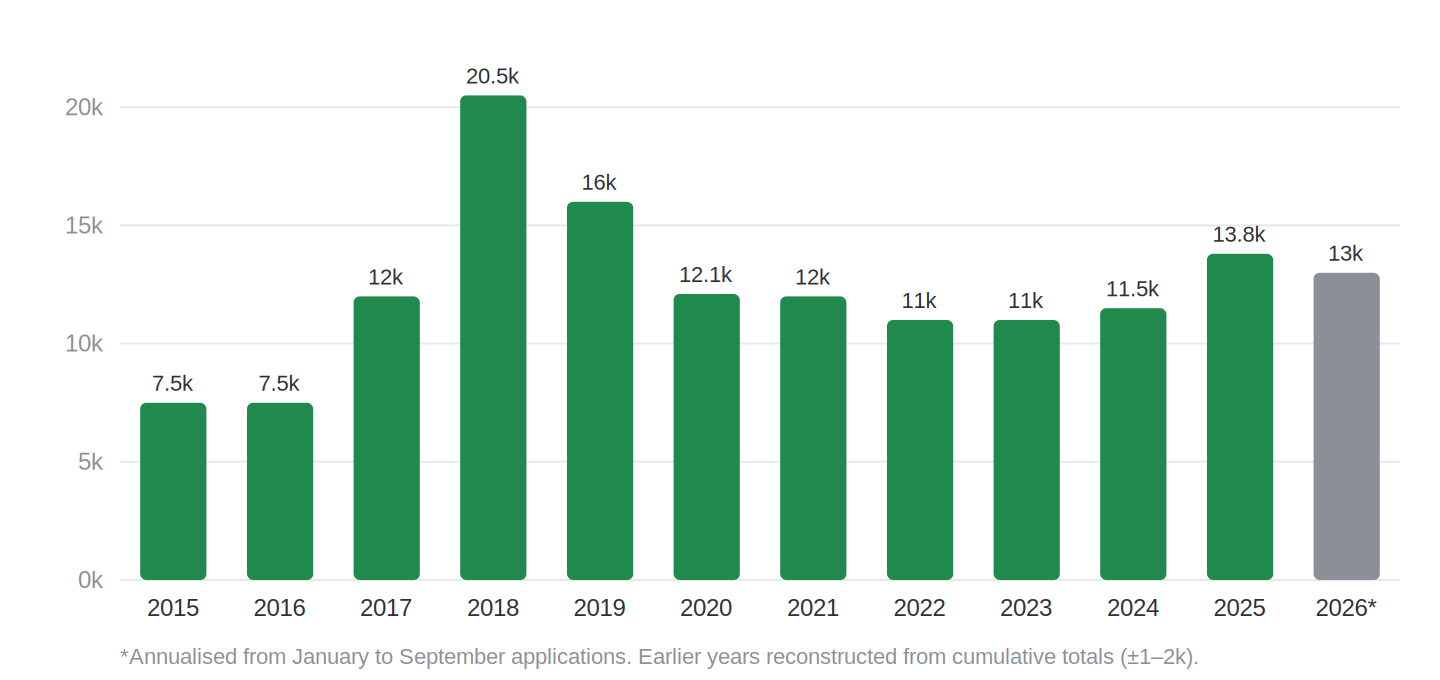
The percentage column looks like a programme losing momentum, but it is just arithmetic: the same 12,000-odd people added to an ever larger base give a smaller percentage each year. The absolute inflow is flat, and for a projection that is the useful fact. e-Residency growth is linear, not exponential, and a straight line is easy to extend.
Estonia’s Population Is Going the Other Way
Estonia’s population peaked at 1,374,687 two years ago and stood at 1,360,745 at the start of this year, down 9,250 in a single year. Deaths already exceed births by more than 6,000 a year, and last year net migration turned negative for the first time in over a decade. Statistics Estonia’s main population projection foresees a decline of about 167,000 people by the end of its horizon. It is a mild scenario, built on net immigration of around 4,000 people a year, and the last two years have run ahead of it.
| Year | Projected population | Change from the peak |
|---|---|---|
| 2030 | ~1,355,000 | −1.4% |
| 2050 | ~1,318,000 | −4.1% |
| 2085 | ~1,208,000 | −12.1% |
| 2100 (extrapolated) | ~1,160,000 | ≈ −15% |
So one line rises by about 13,000 a year, and the other falls by 2,000–3,500 a year in the official scenario or 5,000–9,000 a year at the pace of the last two years. The gap between them, about 1.22 million people today, closes at roughly 16,000 a year on the official numbers. From here on, the answer depends entirely on what you decide an “e-resident” is.
Model 1: Counting Everyone Ever Granted e-Residency
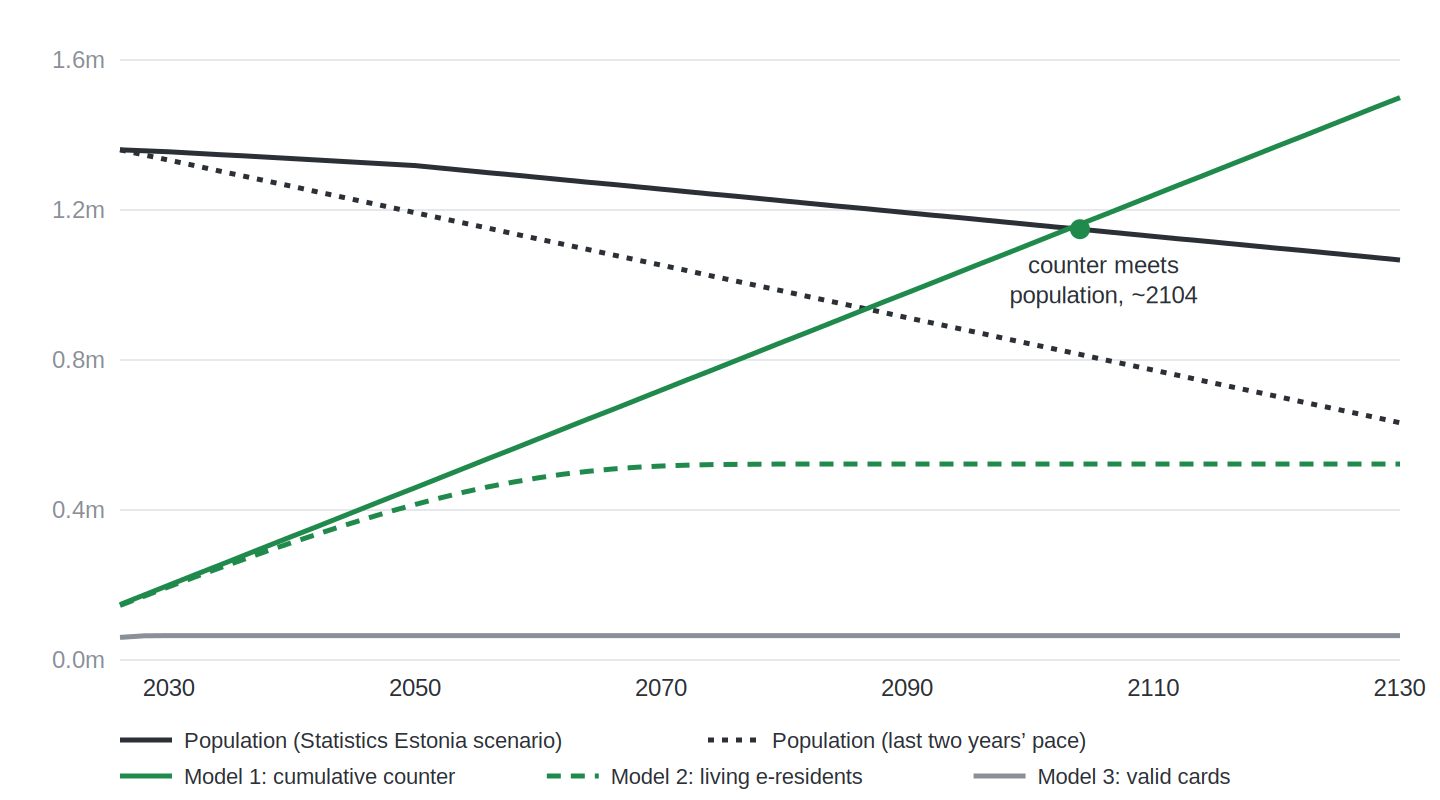
The headline number on the dashboard is cumulative. Everyone ever granted e-Residency stays in it: those who let their card lapse, those whose status was revoked, and those who have since died. It is a counter, not a census, and treated as a counter the maths is a single division. A gap of 1.22 million closing at 16,000 a year takes about 76 years, so the cumulative total catches the population around the start of the next century. If the population keeps shrinking at the pace of the last two years instead, the meeting point moves forward to the mid-2080s. Estonia’s migration policy, in other words, matters more to this date than anything the e-Residency programme does.
If you prefer the programme’s own optimism, assume applications grow 3% a year instead of staying flat. The crossing then moves forward to the end of the 2060s; at 5% a year, to the start of the 2060s. Neither trend is visible in the last eight years of data, but it is a fun article, so they earn a mention.
Model 2: Counting Living e-Residents
A fairer comparison counts people who are alive, because the population figure certainly does. The average e-resident is in their early forties: the programme has put the figure at 42, and last year’s country averages ranged from 34 for Tunisians to 47 for Finns. That gives roughly 40 years of remaining life, depending on which mortality table you trust and how kind you are to a group that is 83% male, mostly urban and mostly from countries with decent healthcare.
Feed a constant 13,000 new e-residents a year through a standard mortality curve and something interesting happens. For the first two decades the living total tracks the counter closely, because a 45-year-old rarely dies. Then the founding cohorts reach their seventies and eighties, deaths begin to match arrivals, and the total flattens out at roughly 500,000–550,000 living e-residents. That ceiling is simply annual inflow multiplied by remaining life expectancy, and Estonia’s population at that point is still around 1.2 million.
So at today’s pace living e-residents never outnumber residents. They settle at 40–45% of the population on the official scenario, or around 60% if the population keeps falling at its recent pace, and stay there. To cross the line within this century the programme would need either sustained 3% annual growth in applications, which gets there in the 2070s, or an inflow of about 30,000 a year, more than double today’s, which gets there in the 2080s. The 10 million target, for the record, would need 250,000 new e-residents every year, indefinitely.
Model 3: Counting Valid e-Residency Cards
The strictest definition is the one a border guard would use: who actually holds a valid Estonian digital ID? The programme’s own figures answer that. Against 135,000 statuses ever granted, there were just over 63,000 valid cards in circulation at the start of the year. That is the same figure the programme reported three years ago, when it celebrated its 100,000th member: the cumulative total keeps climbing, the number of valid e-Residency cards does not. A card is valid for five years, and 63,000 is almost exactly five years of new applications. The arithmetic implies that most e-residents do not renew when their card expires; they got what they needed, or found they needed nothing.
On this definition e-residents are 4.6% of Estonia’s population. The stock grows only if new applications outpace non-renewals, and with the inflow flat it does not. Model 3 is a horizontal line, and it will never cross anything.
Three Definitions, One Chart
| Definition of “e-resident” | Today | Long-run ceiling | Overtakes population (official scenario) | Overtakes population (recent pace) |
|---|---|---|---|---|
| Everyone ever granted the status | ~144,000 | None | Early next century | Mid-2080s |
| Living e-residents | ~140,000 | ~520,000 | Never | Never |
| Valid cards | ~63,000 | ~65,000 | Never | Never |
So whether e-residents ever outnumber Estonians comes down to a definition, and the two honest definitions say no. What could change that, in order of importance:
- Annual inflow. Every extra 5,000 applicants a year brings the counter’s crossing forward by almost 20 years and lifts the living ceiling by about 200,000.
- A growth trend. A permanent 3% a year is worth more than any single record year, and the programme has not managed one since its launch.
- Card-free e-Residency. A fully mobile digital identity, due in the next couple of years, could lift both applications and renewals; the programme’s own estimate is at least 20% more companies.
- Estonia’s demography. The last two years of decline outran the official scenario. If that continues, the lines meet in the 2080s rather than the 2100s, which is not an outcome anyone in Tallinn is rooting for.
Notice what is missing from that list: companies. Whether e-residents outnumber Estonians is a question about digital identities. Whether the programme works is a question about businesses, a more serious conversation we have had in a companion piece on what the official numbers leave out.
e-Residency Is a Tool, Not a Population
Whichever model you prefer, the practical conclusion is the one we give clients every day. The card is a means of running an Estonian company from anywhere, not an end in itself, and the programme’s own numbers say most holders never get past the first step. If you are thinking of applying for e-Residency because you have a real, location-independent business that needs an EU home, we can tell you before you apply whether the company, the payment account and the tax registration are likely to work in your situation. That way you end up in the statistic that matters: companies that trade.
Frequently Asked Questions
The programme’s dashboard shows a little over 142,000 e-residents in total, growing by roughly 13,000 a year. That figure is cumulative and includes people whose cards have expired or whose status has been revoked. Valid e-Residency cards in circulation number just over 63,000.
No. New applications have stayed in a band of 11,000–14,000 a year for eight years, with a single peak of 20,520 in the programme’s fourth year. The percentage growth of the total falls every year because the same inflow is divided by a larger base.
Counting everyone ever granted the status, around the start of the next century at the current pace, or the mid-2080s if the population keeps shrinking as fast as it has in the last two years. Counting living e-residents, never: the total levels off at roughly half a million against a population of about 1.2 million. Counting valid cards, e-residents are under 5% of the population and not gaining.
At the current inflow of about 13,000 a year, the cumulative total reaches roughly 460,000 by mid-century, of whom around 415,000 would still be alive. Estonia’s population is projected at about 1.32 million by then, so living e-residents would be just under a third of it.
No. e-Residency is a digital identity for using Estonian e-services and running a company remotely. It is not citizenship, residency or a visa, which is why comparing e-residents with residents is a game rather than a policy question.
Note
This is a light-hearted projection, not a forecast. Sources are the e-Residency programme’s public dashboard and press releases and Statistics Estonia’s population figures and projection, as linked in the text. Historical yearly totals are reconstructed from published milestones and rounded. The mortality model is a simple Gompertz curve with a single entry age of 42; a more careful model would move the living-e-resident ceiling by a few tens of thousands without changing the conclusion.